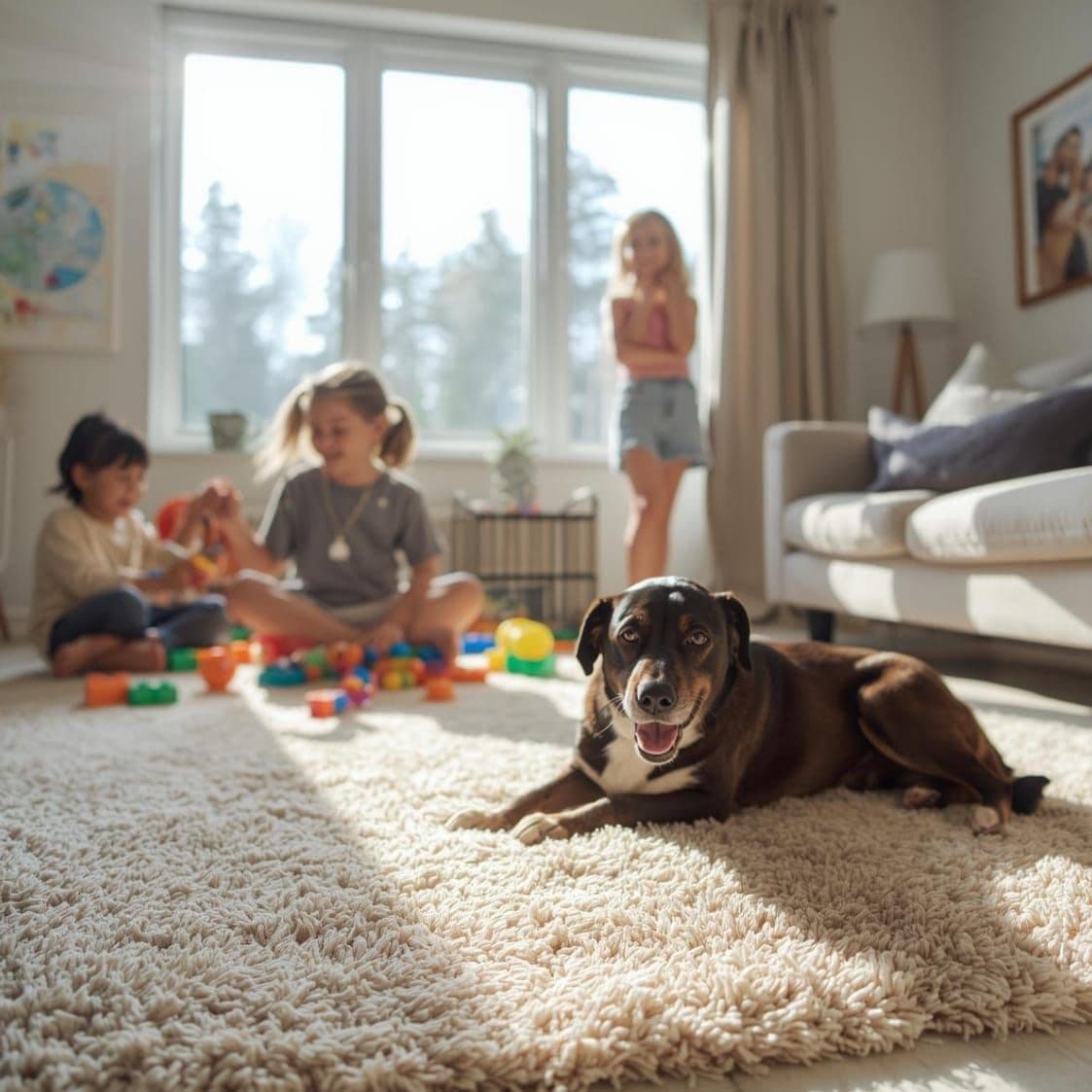
You love your dog. You don't love what your dog did to the carpet in the bonus room.
If you've already tried the enzyme spray from the pet store and the baking soda trick from the internet, you're not alone. Most Brentwood homeowners we talk to have gone through at least two or three products before they call us. The smell goes away for a few days, then it's back, and sometimes it's worse than before.
Here's why that keeps happening, and what actually fixes the problem.
The Real Reason Store-Bought Products Don't Last
When a dog or cat has an accident on carpet, the urine doesn't just sit on the surface. It soaks through the carpet fibers, past the carpet backing, and into the pad underneath. In bad cases, it reaches the subfloor.
Most spray products you'll find at the store are designed to treat the carpet surface. They contain enzymes that break down uric acid crystals, and they do work on the fibers they actually reach. The problem is they rarely get deep enough to hit the pad, which is where the bulk of the urine ends up.
So you spray, it smells better, the enzymes do their job on the top layer, and you think it's fixed. Then humidity rises (it's Tennessee, so give it a day or two) and the moisture reactivates the uric acid crystals sitting in the pad. The smell returns.
What Makes Professional Treatment Different
A proper pet odor and stain treatment has to reach the pad. That's the whole ballgame.
At Safe-Dry, the process works in layers. We treat the carpet fibers first, then apply a solution that penetrates through the backing and into the pad where the urine has settled. The treatment breaks down the uric acid at every level, not just the surface.
For older or repeated accidents in the same spot, the pad may be saturated beyond what any treatment can fix. We'll tell you if that's the case. Sometimes replacing a small section of pad is the most honest answer, and it's cheaper than re-treating the same spot over and over.
How to Tell If the Problem Is in the Pad
A few signs that urine has gone past the carpet surface:
- The smell comes back after cleaning. If you've cleaned the spot and it smells fine for a few days but returns, the pad is holding onto it.
- The carpet feels stiff or crunchy in that area. Dried urine crystallizes, and when it's deep enough, you can feel the texture change.
- A blacklight shows a larger stain than what's visible. Urine spreads once it hits the pad, so the affected area below is usually wider than the surface stain.
- You've cleaned the same spot more than twice. Repeated surface treatments without addressing the pad just add moisture to an already contaminated area.
What to Do Right After an Accident
Speed matters. Here's the best thing you can do before a professional can get there:
- Blot with paper towels or a clean cloth. Press down firmly to pull up as much liquid as possible. Don't rub. Rubbing pushes the urine deeper into the fibers.
- Stack towels and stand on them. Your body weight helps pull moisture out of the carpet and pad.
- Skip the heat. Don't use a steam cleaner or hot water on a fresh pet stain. Heat sets uric acid and can make the stain permanent.
- Avoid ammonia-based cleaners. Ammonia smells like urine to your pet, which can actually encourage them to go in the same spot again.
Repeat Offenders
If your pet keeps going back to the same area, it's almost certainly because they can still smell the urine even after you've cleaned it. Their noses are far more sensitive than ours. Until the uric acid is fully broken down at every level, including the pad, they'll treat that spot as their designated bathroom.
Getting the area properly treated usually breaks the cycle. Once the scent is genuinely gone (not just masked), most pets stop returning to that spot.
When to Call
If you're dealing with pet stains that won't quit, or you've moved into a Brentwood home and the previous owners had pets you can smell but can't see, give us a call at 615-392-5905. We'll take a look, be straight with you about what's fixable, and put together a plan.
You can also schedule a visit online if that's easier.